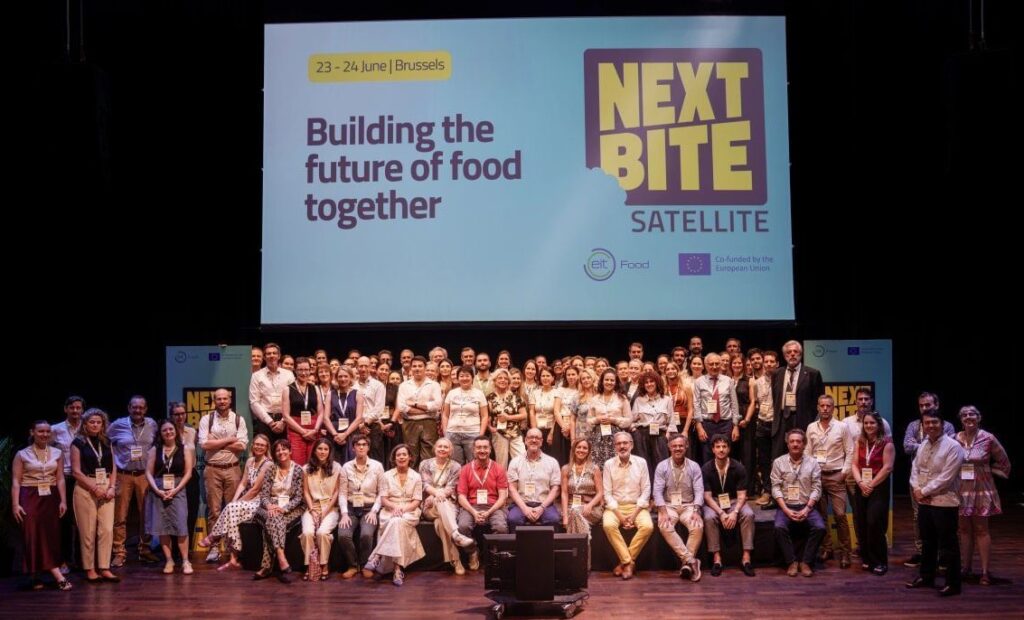
On 23 and 24 June, Wagralim, Biotech4Food project coordinator participated in the EIT Food Next Bite Satellite Event in Brussels, bringing together key European stakeholders to discuss this year’s theme: “From Innovation to Adoption: Biotech and Farming as One System.” The event highlighted the strategic role that agri-food biotechnology will play in strengthening Europe’s food security, resilience, competitiveness and One Health approach, in line with the ambitions of the upcoming European Biotech Act.
Building the European Agri-Food Biotech Alliance
The first day focused on the European Agri-Food Biotech Alliance, launched and coordinated by EIT Food to build a stronger and more connected ecosystem supporting food biotechnology innovation across Europe. As members of the EIT Food network, Biotech4Food partners Wagralim, Flanders’ FOOD and CNTA are actively involved in these discussions.
Participants worked in dedicated thematic groups to identify priority actions in key areas including regulation, financing and investment, collaborative R&I, acceleration and scale-up, skills and talent, stakeholder engagement and the creation of a European Joint Undertaking (JU) dedicated to agri-food biotechnology. Several Biotech4Food project outputs—including the mapping of the European food biotechnology ecosystem, the identification of support services for SMEs, good practices for interregional collaboration and the needs expressed by innovative companies—will contribute to the ongoing work of the Alliance and help inform its future recommendations.
Wagralim joined the Stakeholder Engagement working group, where discussions highlighted the need to make Europe’s innovation ecosystem more accessible to startups and SMEs. A key proposal emerging from the workshop was the development of a European Startup Playbook gathering, in one place, the technical infrastructures, pilot facilities, funding opportunities, regulatory support services and business acceleration programmes available to innovative companies.
Accelerating innovation through collaboration
The second day featured networking sessions and inspiring panel discussions on financing, collaborative innovation, talent development, ecosystem building and systemic transformation.
A recurring message throughout the event was that Europe already has world-class scientific excellence. The challenge now is to accelerate the transition from research to industrial deployment by strengthening collaboration between innovators, industry, investors and policymakers.
Speakers also stressed the importance of involving consumers and markets from the earliest stages of innovation. Rather than focusing communication on biotechnology itself, companies should emphasise the tangible benefits of their products—such as taste, nutrition, sustainability and affordability—using clear and accessible language that resonates with consumers.
Looking ahead
One of the event’s highlights was a keynote on China’s long-term food strategy, illustrating how coordinated public policies and sustained investments are positioning China to become a global leader in food biotechnology over the coming decades.
The conclusion was clear: Europe still has a significant opportunity to lead, provided it acts now by making strategic choices, strengthening collaboration across the innovation ecosystem and accelerating the market adoption of biotechnology-based solutions.
A strong alignment with Biotech4Food
The discussions held during the Next Bite Satellite Event strongly resonate with the mission of Biotech4Food: accelerating the adoption of innovative food biotechnologies by supporting SMEs, strengthening interregional collaboration and helping companies overcome technological, financial and market barriers. Through its activities—including innovation support, networking opportunities, access to expertise and ecosystem development—Biotech4Food contributes to building exactly the type of collaborative European environment highlighted during the event.
As Europe prepares its future Biotech Act, initiatives like Biotech4Food demonstrate how regional ecosystems can play a key role in transforming scientific excellence into industrial innovation, sustainable growth and more resilient food systems